

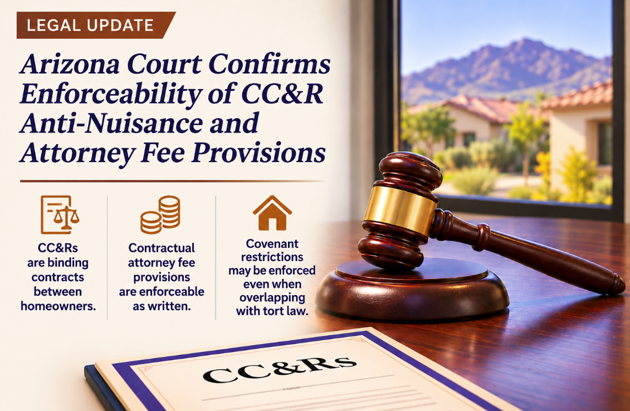
In an important decision affecting homeowners and homeowners’ associations (“HOAs”), the Arizona Supreme Court recently clarified the enforceability of recorded covenants, conditions, and restrictions (“CC&Rs”) and the availability of contractual attorney fees in disputes between neighboring property owners.
In Burkett v. Dryja, —-P.3d—–, 2026 WL 3227071 (2026), the Supreme Court held that an anti-nuisance provision contained in recorded CC&Rs creates an independently enforceable contractual obligation between property owners, even if the same conduct could also constitute a separate common-law tort claim. No. Id. at ¶¶ 1-3, 14-33. The Supreme Court also confirmed that attorney fee provisions in CC&Rs are enforceable as written, even when Arizona statutory law would not otherwise permit recovery of attorney fees under A.R.S. § 12-341.01(A).[1] Id. at ¶¶ 34-46.
The dispute arose between neighboring property owners in an HOA. After the defendants installed a new air conditioning unit, their neighbor alleged that the noise and vibrations violated the CC&Rs’ anti-nuisance provision. The trial court ruled in favor of the defendants, finding that the noise, although annoying, did not constitute an actionable nuisance or violate the CC&Rs. However, the trial court denied the defendants’ request for attorney fees by reasoning that the claim sounded in tort rather than contract because Arizona common law separately prohibits nuisances.
The Arizona Court of Appeals affirmed, concluding that the anti-nuisance provision merely restated duties already imposed by common law and therefore did not independently support contractual fee recovery. Id. ¶ 10.
The Arizona Supreme Court disagreed and provided three defining principles for HOAs to use moving forward.
The Burkett Case’s Three Defining Principles
- Recorded CC&Rs create enforceable contractual obligations between property owners – not just between property owners and the HOA;2
- A contractual provision remains enforceable per the CC&Rs even when it overlaps with an existing tort duty;3
- Arizona law does not require separate consideration for each individual contractual provision.4
Why the Burkett Decision Matters for HOA and Property Owners
Burkett reinforces the importance of carefully reviewing CC&Rs before pursuing or defending an enforcement action. Property owners may have independent contractual rights against neighbors, and those rights may extend beyond the protections available under common-law nuisance principles.
But perhaps most importantly, the decision highlights the potential financial consequences of covenant enforcement disputes. Where CC&Rs contain prevailing-party attorney fee provisions, an unsuccessful property owner may be responsible for the opposing party’s reasonable attorney fees, even when the underlying dispute involves conduct traditionally associated with tort law. Conversely, property owners who successfully enforce their contractual rights may likewise be entitled to recover fees.
For property owners and associations alike, Burkett highlights the importance of evaluating not only the merits of a potential CC&R violation, but also the governing documents’ enforcement and attorney fee provisions before initiating litigation.
If you or your association have questions regarding HOA governance, enforcement matters, or any other community association issue, please contact Provident Law® to schedule a meeting with Attorney Dominick Detente or one of the other experienced real estate attorneys at the firm.
[1] Under A.R.S. § 12-341.01(A), courts may award reasonable attorney fees to the successful party in a contested action arising out of contract.
Dominick Detente, Esq. focuses his practice on homeowner’s association law, real estate litigation, and construction-related disputes throughout Arizona. He regularly advises on governance, compliance, enforcement, and risk-management issues. Drawing upon a multi-generational background in the roofing and construction industry, Mr. Detente provides clients with practical, business-oriented solutions to complex legal challenges. He earned his J.D. from Arizona State University’s Sandra Day O’Connor College of Law and graduated summa cum laude from ASU’s W. P. Carey School of Business where he was recognized as an Outstanding Graduate Finalist. He can be reached at Dominick@ProvidentLawyers.com or 480.388.3343.