


Legal Update
June 2026
HOA Executive Sessions Are Not a Place to Hide Board Business
By: Dominick Detente, Esq.
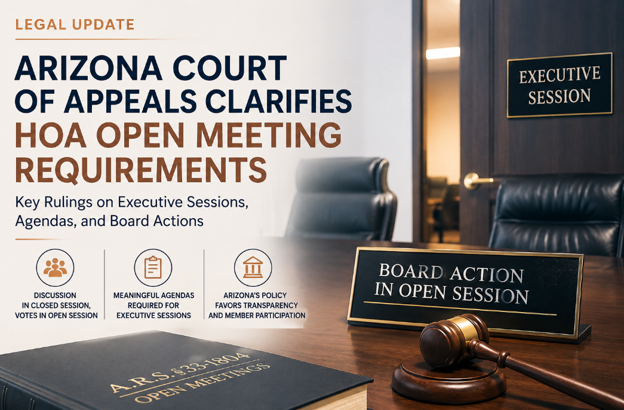
Arizona boards have long treated executive session as a place where difficult issues can be discussed privately and, in many cases, decided privately. The Arizona Court of Appeals has now made clear that executive session is not the forum for board decisions.
Arizona HOA attorneys, managers, and board members will come to know this simply as the “Sunland Springs Decision.”
In A Z N H Revocable Trust v. Sunland Springs Village Homeowners Association, 1 CA-CV 25-0424 (Ariz. App. Apr 28, 2026), the Court of Appeals interpreted A.R.S. § 33-1804, Arizona’s HOA open meeting statute, and clarified two important points for planned communities:
- executive sessions are for discussion, not decision-making voting; and
- executive-session agendas must contain meaningful descriptions of the topics to be discussed.
The decision does not correct one association’s procedures. It changes how all Arizona associations approach executive sessions.
- Executive Session is for Discussion Only, Not Decision-Making
The central holding is straightforward: a board may discuss certain sensitive matters in closed session, but all votes must occur in open session.
That distinction changes how Arizona associations have historically conducted business.
Reasoning:
The statute allows a closed portion of a meeting for the “consideration” of limited subjects, including legal advice, pending litigation, personal or financial information, personnel issues, and certain violation appeals.[1] The association argued that “consideration” included voting in executive session, a position that most all associations have historically followed.
The Court rejected that argument, and reasoned that “consideration” is not the same thing as “action.”[2] A board can receive legal advice, discuss litigation strategy, evaluate a delinquent account, or consider a personnel issue in executive session. But once the board is ready to act, the action must come back into the open.
This does not mean the board must over-disclose privileged and sensitive information. It means the board must conduct the actual governance act, the motion and vote, in open session.
That is the line the Court drew.
- Meaningful Agendas
The more nuanced holding is the Court’s ruling on agendas.
First, it is important to distinguish between notices and agendas. The Court held that:
Notices remain sufficient if they contain the “date, time and place of the meeting” and “must list the paragraph under Section 33-1804(A) that justifies the closed
meetings” according to A.R.S. § 33-1804(B). Sunland Springs, ¶ 19. Additionally, notices primarily serve to “inform association members when and where a meeting will take place, and what type of meeting it is,” according to A.R.S. §§ 33-1804(C) & (D). Id. at ¶ 20.
While agendas serve to “contain the information that is reasonably necessary to inform the members of the matters to be discussed,” according to A.R.S. § 33-1804(F). Id. at ¶ 9.
Thus, the agenda is different. As standard practice, many associations have used executive-session agendas like they would a notice by saying little more than:
“Legal matter – A.R.S. § 33-1804(A)(1)”
or
“Personnel issue – A.R.S. § 33-1804(A)(4).”
The Court held that this is not enough.
A bare statutory citation is not adequate notice. It identifies the legal category for closing the meeting, but not the subject matter of the discussion.
That is the flaw, according to the Court of Appeals
An agenda does not need to reveal confidential information, but it must give a meaningful general description. For example:
[1] Per A.R.S. §§ 33-1804(A)(1)-(5).
[2] As the Court explained, “consideration encompasses[] thought and discussion about matters” and “does not encompass voting, which is the formal expression of a final decision that occurs after a matter has been considered.” Sunland Springs, ¶ 11.
- Legal advice regarding common-area maintenance obligations (A.R.S. § 33-1804(A)(1))
- Discussion of pending litigation concerning alleged property damage within the community (A.R.S. § 33-1804(A)(2))
- Review of a homeowner’s request involving confidential financial information (A.R.S. § 33-1804(A)(3))
- Personnel matter regarding association employee performance (A.R.S. § 33-1804(A)(4))
- Owner appeal relating to an alleged violation of the community’s governing documents (A.R.S. § 33-1804(A)(5))
Those descriptions preserve confidentiality while still telling the membership what kind of association business is being handled and satisfying A.R.S. § 33-1804(F).
Strategically Reading Between the Lines: Transparency Without Over-Disclosure
These examples illustrate the balance associations must now strike following the Sunland Springs Decision.
On one hand, agenda descriptions that are too vague may fail to provide members with information reasonably necessary to understand business being discussed, potentially exposing the association to liability under A.R.S. § 33-1804. On the other hand, however, descriptions that are too detailed may unnecessarily disclose information the association is not prepared, or required, to release and potentially lose valuable footing.
The challenge going forward will be finding the middle ground.
For example, an agenda item stating “pending litigation” is too vague, while an agenda item stating “discuss settlement authority regarding construction defect with Lot #3” may reveal far more than necessary. A description such as “discuss legal advice involving settlement authority regarding construction defect” likely provides members with a meaningful understanding of the subject matter without disclosing strategy, settlement posture, or privileged information.
The Court did not define where that line exists, and Arizona HOA attorneys, managers, board members, and homeowners will be left to decide that line for themselves.
Leftover Gray Area: Personal Information?
So where will the line ultimately be drawn? The Court made clear that merely citing a statutory subsection is insufficient, but it did not establish how much identifying information must be disclosed to satisfy A.R.S. § 33-1804.
For example, for a violation appeal, must the agenda identify the lot number or homeowner involved, or merely describe the nature of the alleged violation?
This uncertainty is particularly important because several of the statutory bases for executive session exist precisely to protect confidential and personal information, while, at the same time, public policy leans toward open disclosure.
These questions remain unresolved. As associations attempt to balance transparency against confidentiality and privacy concerns, differing approaches will still inevitably emerge in a post-Sunland Springs era.
As a result, the Sunland Springs Decision will generate additional disputes and litigation as courts are asked to further define where the boundary lies between meaningful disclosure and over-disclosure, especially as it relates to personal information.
Rather than closing the door on these issues, the decision adds another important layer to Arizona’s developing body of HOA law.
What Arizona Associations Should Do Now
This case should not be ignored or minimized. It is now the leading Arizona appellate decision on HOA executive sessions under A.R.S. § 33-1804.
Boards should immediately stop taking votes in closed session. They should revise executive-session agenda language. They should return to open session before making motions or taking action. They should keep minutes clean and limited, without disclosing privileged or confidential details. And they should identify the statutory basis for closed sessions.
The message from the Court is clear: executive session is a narrow exception to open governance. It is not a second boardroom where association business can be decided outside member scrutiny.
That is the practical takeaway, and associations that do not adjust their procedures accordingly are inviting avoidable legal challenges.
If you or your association have questions regarding HOA governance, executive sessions, board meetings, enforcement matters, or any other community association issue, please contact Provident Law® to schedule a meeting with Mr. Detente or one of the other experienced real estate attorneys at the firm.
Dominick Detente focuses his practice on homeowner’s association law, real estate litigation, and construction-related disputes throughout Arizona. He regularly advises on governance, compliance, enforcement, and risk-management issues. Drawing upon a multi-generational background in the roofing and construction industry, Mr. Detente provides clients with practical, business-oriented solutions to complex legal challenges. He earned his J.D. from Arizona State University’s Sandra Day O’Connor College of Law and graduated summa cum laude from ASU’s W. P. Carey School of Business where he was recognized as an Outstanding Graduate Finalist. He can be reached at Dominick@ProvidentLawyers.com or 480.388.3343.
This article is provided for informational purposes only and does not constitute legal advice. The information contained herein may not apply to your specific circumstances and should not be relied upon as a substitute for obtaining legal advice from qualified counsel. Reading this article does not create an attorney-client relationship with Provident Law® or any of its attorneys.